

Blog
What is zero-click search? A leader's guide to the new rules of visibility
Sophie Carr
CEO & Founder, GAIO Tech
12 min read
TL;DR
For years, marketing was about getting a seat at the search results table. That’s what SEO did. But now, the AI is the host of the conversation, and if it isn’t talking about you, you might as well not be in the room. This new reality is driven by zero-click search, and it requires a new playbook. It’s called Generative Artificial Intelligence Optimisation (GAIO), a strategy for moving from just having a seat to being the guest of honor.
What is zero-click search?
Zero-click search definition: A zero-click search occurs when a user’s query is answered directly on the search engine results page (SERP), eliminating the need to click on any website link.
Search engines deliver this instant gratification through a growing suite of features that have become the new main event. Understanding each one is key to building a winning strategy, especially as the line between typing and talking to an AI begins to blur.
Comprehensive zero-click search features guide
1. AI Overviews — The current heavyweight champion. These are comprehensive, AI-generated summaries that sit at the very top of the search results, often synthesizing information from multiple sources to provide a complete answer. For a brand, being the primary source for an AI Overview is the ultimate mark of authority.
2. Voice Search & AI Assistants — The purest form of zero-click search. When a user asks a question to Gemini, Siri, or Alexa, they receive a single, verbal answer. There is no list of options. Winning the verbal answer from an AI assistant means your brand becomes the singular, trusted authority in that moment.
3. Interactive SERP Tools & Widgets — The evolution of search into an application. These are functional tools (like flight trackers, mortgage calculators, or sports scoreboards) that live directly on the results page, allowing a user to complete a task without ever leaving Google. Winning here means being the data provider that powers these tools.
4. Featured Snippets — The original “answer box.” This is a concise block of text pulled from a single authoritative source that directly answers a user’s question. Winning the Featured Snippet positions your brand as the go-to expert for a specific query.
5. Knowledge Panels — Your brand’s digital business card. This is an information box that summarizes key details about your company, its leaders, and its products. Optimizing this is about owning your brand’s story when someone searches for you directly.
6. People Also Ask (PAA) Boxes — A goldmine of customer intelligence. This is a list of related questions that expand to show brief answers. Dominating the PAA boxes for your core topics means you are guiding your customer’s entire research journey.
7. Direct Answer Boxes — Instant gratification for factual queries. These provide immediate answers for things like currency conversions, definitions, or weather forecasts, often pulled from the search engine’s own data. Their existence trains users to expect immediate answers for everything.
8. Rich Carousels (Products, Images, Videos) — Swipeable, visual results that satisfy intent without clicks. A user looking for “red running shoes” might find the perfect pair in an image carousel and search for that brand directly later. Appearing in these carousels is critical for visual and e-commerce brands.
9. Local Map Packs — The driver of real-world action. For any “near me” search, this is the map with business listings and reviews that often determines which local business gets a visit or a call. For any business with a physical presence, winning the Local Pack is non-negotiable.
The new rules of the room: why your seat is no longer enough
Let’s be clear: a seat at the table—a link on the search results page—is still important. Your SEO team’s work is vital. But their work now only gets you into the room. The most important conversation is happening at the head of the table, and it’s being led by the AI.
The number of people who never leave that main conversation is growing. This isn’t just a change in user behavior; it’s a fundamental change in the flow of influence. This changes the critical question for every leader. It’s no longer just, “How do I get a seat at the table?”. It’s, “How do I get the host to talk about me?”.
Your new playbook: the GAIO framework
When the rules of the room change, you need a new playbook. That’s why I created GAIO, or Generative Artificial Intelligence Optimisation. The analogy is simple: Traditional SEO was about getting your website a good seat at the table. GAIO is about making sure the host—the AI—is talking about you, recommending you, and positioning you as the guest of honor. It’s a strategy for teaching AI models to recognize and trust your authority.
With GAIO, you’re set up to:
- Win Visibility: Because if you’re not in the AI’s answer, you’re invisible.
- Establish Authority: This is about turning your expertise into a competitive moat by becoming the trusted source the AI recommends.
- Grow Revenue: We connect this new kind of influence directly to sales and growth.
The five pillars of GAIO
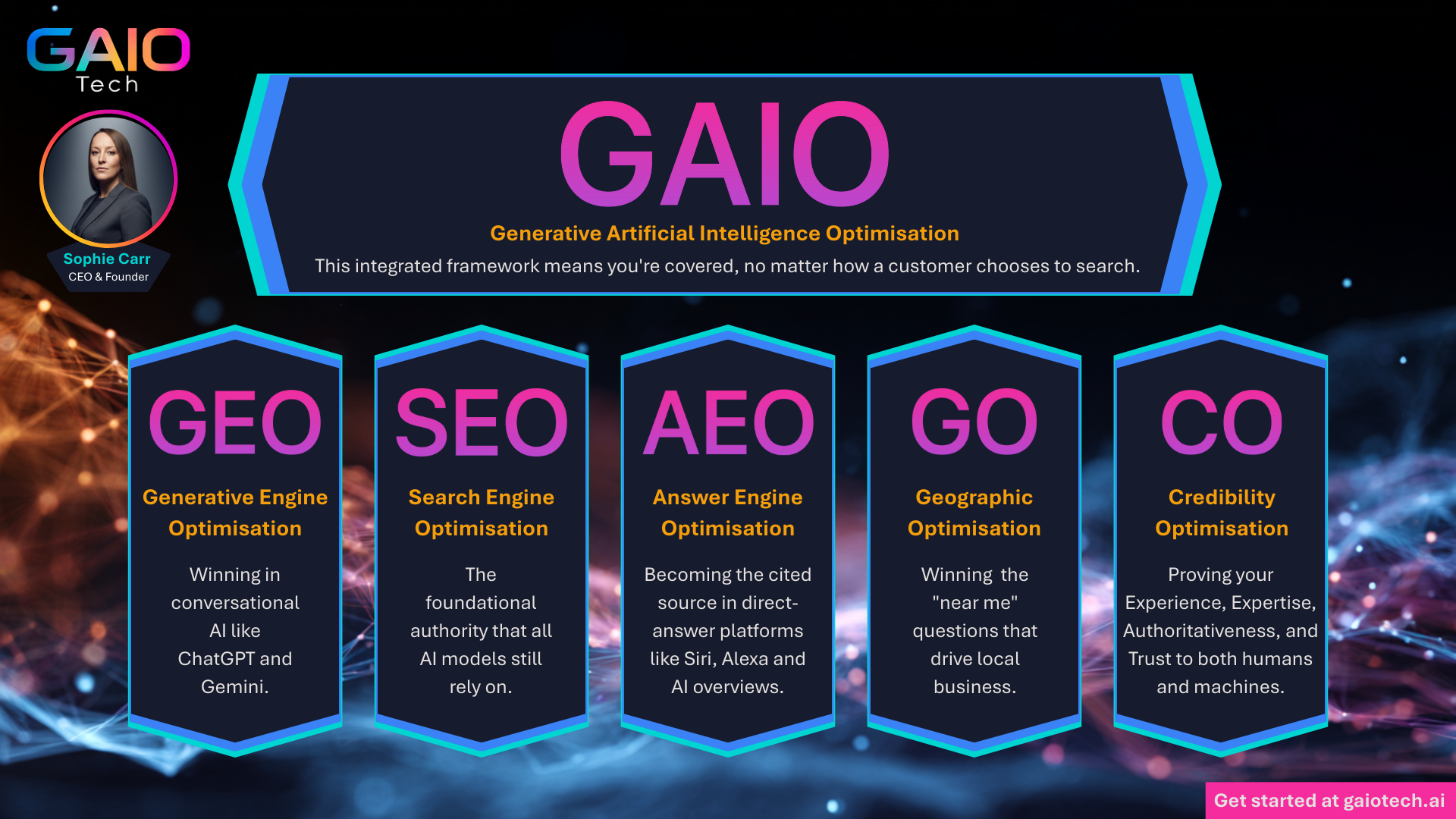
GAIO is a holistic strategy, built on five pillars that work together to make you the guest of honor:
GEO (Generative Engine Optimisation) — Owning the main conversation in AI like ChatGPT and Gemini.
SEO (Search Engine Optimisation) — Securing your foundational seat at the table, which all AI models still respect.
AEO (Answer Engine Optimisation) — Becoming the trusted source the AI host cites in its direct answers.
GO (Geographic Optimisation) — Ensuring you’re the answer when the conversation is about “near me.”
CO (Credibility Optimisation) — Proving to everyone in the room—humans and machines—that you deserve to be the authority.
The new north star: are you part of the conversation?
How do you measure success in this new room? You need a new North Star. That new KPI, the one that belongs in the boardroom, is AI Share of Voice (AI SoV).
AI SoV is the number that tells you if you’re actually part of the conversation. It measures:
- How often your brand is mentioned for the questions that matter
- How you stack up against others at the table
- If the AI sees you as a credible source
It’s the metric that tells you if you’re just a name on the seating chart or the guest everyone wants to hear from.
Your 3 steps: a blueprint for influence
This isn’t a “wait and see” moment; it’s a time to act. Here’s a simple 3-step blueprint for how you can start earning your influence.
Step 1: Define Your Strategy
- Target Key Conversations: Focus on the questions that have the biggest impact on your customers and your revenue.
- Deploy the 5 Pillars: Start systematically optimizing your digital presence using the GAIO framework to build your authority.
- Be the Expert: Ensure your content is clear, authoritative, and answers your customers’ questions better than anyone else at the table.
Step 2: Assess Your Position
- Benchmark Your AI SoV: First, you need to know where you stand. Are you even in the room? Analyze your current AI Share of Voice on your most important business questions.
- Identify the Guests of Honor: See who is currently being talked about in your space. Who does the AI already trust and cite?
- Find the Empty Chairs: Identify the high-value conversations where your brand has no presence at all.
Step 3: Measure and Expand
- Track Your Influence: Continuously monitor your AI SoV to see the direct impact of your work.
- Double Down on What Works: See what’s making a difference and reallocate your resources accordingly.
- Claim More Territory: Once you’ve become the authority on core topics, expand your strategy to become the guest of honor in adjacent conversations.
From theory to practice: claiming our seat at the table
It’s one thing to talk about a framework in theory. It’s another to see it work in practice. I want to share a story from our own recent experience.
After our pivot to GAIO Tech, our initial efforts paid off. We had secured our seat at the table for our core brand terms, like “GAIO Tech.” But last week, we saw that for the broader, more important conversation—“What is GAIO?”—we weren’t even in the room. The AI wasn’t talking about us at all.
So, we used our own playbook. We put the platform to work with the focused goal of earning our place in that conversation. The results were astonishingly fast. In just a couple of days, Gemini was recommending us, positioning us as the guest of honor—sometimes even above Forbes. ChatGPT is always a bit slower, but Gemini’s quick reaction shows how rapidly you can influence the conversation when you have the right strategy.
Your strategic questions, answered
1. How does GAIO differ from our current SEO strategy?
SEO gets you a seat at the table. GAIO makes you the guest of honor. While SEO focuses on ranking your website, GAIO is a broader framework for making your brand the AI’s recommended answer. It integrates SEO as a critical pillar but adds GEO, AEO, GO, and CO to ensure you’re the one leading the conversation.
2. Is SEO still a necessary investment?
Absolutely. Your seat at the table (SEO) is a prerequisite. AI models rely on the foundational authority of websites to decide who to talk about. A strong SEO strategy, focused on E-E-A-T, is essential. However, it’s no longer sufficient for winning the main conversation.
3. How do we measure the ROI of GAIO?
GAIO ROI is measured through “AI Share of Voice.” This KPI tracks your visibility within the AI’s answers for high-value queries. We connect this metric directly to business outcomes like lead generation and market share, providing a clear picture of your return on influence.
4. How does this framework apply to a global enterprise?
GAIO is a global framework with local execution. The “Geographic Optimisation” (GO) pillar is designed to make you the guest of honor in every room, winning “near me” and location-based conversations in all your target markets, from the EU to the USA to Asia.
5. What is the immediate first step for my organization?
First, find out if you’re even in the room. You need to establish a data baseline by auditing your current AI Share of Voice for your most important keywords. This benchmark becomes the foundation for your strategy to claim your place in the conversation.
An Invitation: Your First 1000 Tokens Are On Us
I’ve shared the strategic framework and our own story of putting it into practice. But seeing the data for your own brand is when the reality of this shift truly hits home.
You can’t manage what you don’t measure. That’s why I want to make it easy for you to get started.
About the Author
Sophie Carr, CEO & Founder
Sophie Carr is the CEO and Founder of GAIO Tech, a Founder Institute 2025 Graduate who pioneered the field of Generative Artificial Intelligence Optimisation (GAIO). As a leading authority on AI search optimisation and context engineering, Sophie helps enterprises establish strategic visibility in AI platforms like ChatGPT, Gemini, and Perplexity.
GAIO Tech is the startup Sophie founded to turn her winning Generative Artificial Intelligence Optimisation strategies into easy-to-use context engineering software that makes you the answer in AI search. With expertise spanning enterprise marketing transformation, knowledge graph optimisation, and AI Share of Voice measurement, Sophie’s frameworks have guided billion-dollar brands through the Zero-Click Era transition.