

Blog
AI Share of Voice (AI SoV)
Sophie Carr
CEO & Founder, GAIO Tech
15 min read
The new search KPI you should be tracking if you want to lead in AI search and win in the zero-click era.
What is AI Share of Voice (AI SoV)?
AI Share of Voice (AI SoV) measures how frequently a brand is referenced, cited, or used as a source within AI-generated answers across platforms such as ChatGPT, Google Gemini, and Perplexity. It reflects a brand’s visibility and influence in AI-driven search results, recommendations, and conversational responses rather than traditional search rankings.
TL;DR: Key Takeaways
- AI Share of Voice (AI SoV) measures how often AI platforms like ChatGPT, Gemini, and Perplexity mention your brand vs competitors.
- The formula: AI SoV = (Your brand weight ÷ Total weighted mentions) × 100, where position weight = 1 ÷ position.
- Why it matters: Discovery now happens before the click. High AI SoV means your brand is trusted where decisions are made.
- How to improve: Follow GAIO’s five pillars - SEO for structure, GEO for interpretation, AEO for clarity, GO for localisation, CO for trust.
- Tracking frequency: Measure monthly for trends, quarterly for reporting. Most brands see improvements within 60-90 days.
The Formula
AI SoV = (Your brand weight ÷ Total weighted mentions) × 100- Position weight: 1 ÷ position (1st = 1.00, 2nd = 0.50, 3rd = 0.33)
- Your brand weight: Sum of all position weights across queries
- Total weighted mentions: Sum of all competitor weights in market
Example: Calculating AI SoV
Query: “What is the best CRM for enterprise sales?” AI Response mentions: Salesforce (1st), HubSpot (2nd), Microsoft Dynamics (3rd), Zoho (4th).
Salesforce weight: 1÷1 = 1.00. HubSpot weight: 1÷2 = 0.50. Dynamics weight: 1÷3 = 0.33. Zoho weight: 1÷4 = 0.25. Total = 2.08 → Salesforce AI SoV = (1.00 ÷ 2.08) × 100 = 48.1%.
In practice, GAIO Tech aggregates this across hundreds of queries and multiple AI platforms.
Frequently Asked Follow-Up Questions
What if my brand is not mentioned in AI results at all?
Zero AI Share of Voice means AI platforms have not indexed structured, trustworthy content about your brand. Start by creating clear, well-sourced articles that answer common customer questions. Focus on accuracy, citations, and semantic clarity rather than promotional language. GAIO’s framework can help you build the content foundation AI platforms recognize and trust.
How often should I track my AI Share of Voice?
Monitor your AI Share of Voice weekly for trending queries and monthly for comprehensive brand health assessment. AI platforms update their knowledge bases constantly, so regular tracking helps you catch visibility changes early. GAIO Tech recommends daily tracking during active campaigns and quarterly benchmarking for strategic planning.
Can I optimize for specific AI platforms like ChatGPT or Gemini?
Yes. ChatGPT prioritizes conversational depth and context. Gemini emphasizes knowledge graph integration and Google Search data. Perplexity values citation transparency and source verification. Each platform weighs different signals, but all reward clarity, accuracy, and semantic structure. GAIO’s 10-pillar framework addresses platform-specific optimization while maintaining universal quality standards.
Does AI Share of Voice replace traditional SEO metrics?
No. AI Share of Voice complements traditional SEO by measuring brand visibility in zero-click search environments where users get direct answers without visiting websites. Track both metrics: SEO for traffic and conversions, AI SoV for brand authority and trust signals in AI-generated responses. As search behavior shifts toward AI platforms, AI SoV becomes increasingly critical for long-term visibility strategy.
How long does it take to improve AI Share of Voice?
Expect meaningful improvements within 60 to 90 days of implementing GAIO framework optimizations. AI platforms refresh their knowledge bases regularly, so consistent high-quality content creation and semantic optimization compound over time. Brands that publish weekly structured content typically see 3x to 5x AI visibility gains within one quarter. Fast-moving topics may show results in 2 to 4 weeks.
How do you measure AI share of voice?
Brands can measure their real visibility in AI search with AI Share of Voice: a weighted formula that measures how often and how prominently AI platforms mention your brand compared to competitors.
This is the story of how I created it, why early tracking tools failed, and what it takes to earn AI’s trust when 80% of consumers now rely on zero-click results (Bain & Company, 2024) to make decisions.
By Sophie Carr, CEO & Founder, GAIO Tech
What sparked the creation of the AI Share of Voice formula?
The AI Share of Voice formula was created in response to ChatGPT’s November 2022 launch, when Sophie Carr asked “How do I train AI to talk about my brand?” Testing revealed that AI platforms prioritize structured, credible content over brand reputation. This insight led to developing a weighted visibility model that measures how often and where brands appear in AI-generated responses, proving that strategic content optimization directly influences AI citations.
November 30, 2022. I remember the date because everything shifted.
ChatGPT dropped. Within days, everyone I knew in marketing was panicking about what this meant for SEO. The conversations were the same everywhere: “Will Google die?” “Should we pause our content strategy?” “What happens to our rankings?”
I sat in the middle of all that noise and asked myself a completely different question: “What if I could train AI to understand my brand the way I do?”
Not rank for it. Not optimize around it. Actually teach it.
For the first time in my career, the internet wasn’t just retrieving information anymore. It was reasoning with it. These weren’t search engines… they were thinking machines. And if they were going to think about my clients’ brands, I needed to make sure they had everything they needed to learn about them.
So I started experimenting. Late nights, endless prompts, spreadsheets full of AI responses. I’d ask the same question fifty different ways and log every variation. What made ChatGPT mention Brand A first? Why did it cite Brand B’s methodology but not Brand C’s? What made one company sound authoritative and another one… forgettable?
Patterns emerged. Clear, repeatable patterns.
I started building a technical generative AI optimisation checklist of what I thought would help brands be the answer.
But I had a problem. I needed to measure this. I tested every AI visibility tool I could find (and there weren’t many back then) hoping one of them would show me not just what AI was saying, but how to influence it.
That’s when I saw the cracks.
Why were early AI tracking tools failing to show real visibility?
Early AI tracking tools failed because they treated all brand mentions equally, showing inflated scores of 75-85% for everyone. This made the numbers meaningless: you couldn’t tell who was actually leading. AI platforms like ChatGPT and Gemini actually give more weight to brands mentioned first, meaning position matters more than just being included. These early tools couldn’t measure what really drives AI visibility or show how to improve your brand’s ranking.
The tools looked incredible at first. Sleek dashboards. Colorful pie charts. Big, confident percentages showing you exactly how “visible” your brand was in AI.
Then I looked at the actual math.
It didn’t add up. Literally.
Most tools were doing binary counting: if your brand showed up in an AI response, you got a “1.” If you didn’t, you got a “0.” So if ChatGPT mentioned four brands, each one scored 25%. That’s not measuring visibility… that’s just division. Everyone looked like they were winning, which meant nobody actually was.
And here’s the thing nobody was talking about: position matters. When ChatGPT lists you first versus fourth, that’s not the same level of trust. When Gemini cites your methodology versus just mentioning your name in passing, that’s a completely different signal.
But these tools couldn’t see that. They couldn’t tell the difference between influence and existence.
Worse? Some of them were asking AI to score itself. They’d prompt ChatGPT: “How visible is Brand X on a scale of 1-100?” and then report that number like it meant something. That’s not data. That’s a hallucination with a percentage sign.
I didn’t need another dashboard showing me approximations. I needed to understand the why behind the answer. Which brands got mentioned? Which sources got cited? What context shifted the ranking? What actually moved the needle?
If I couldn’t measure it properly, I couldn’t influence it. And if I couldn’t influence it, what was the point?
So I built something new.
How did the AI Share of Voice formula begin?
The AI Share of Voice formula uses a simple math approach to measure brand visibility fairly. Each brand gets a score based on where it appears in AI answers: being mentioned first earns more points than being mentioned later. The formula is: (your brand’s score ÷ all brands’ combined scores) × 100. This proved that well-structured, credible content directly influences what AI recommends. Within weeks, testing showed clear patterns: better content structure and trusted authorship led to more AI recommendations.
I went back to first principles. Share of voice wasn’t new… it’s been a marketing metric for decades. But applying it to AI? That was uncharted territory.
I found some brilliant academic models… complex, statistically rigorous formulas that could theoretically measure this. The problem is you’d need a PhD in statistics just to plug the numbers into Excel. These weren’t tools. They were research papers.
So I stripped it down.
I built a formula that was simple, transparent, and actually usable. It weighted brand mentions by position (because being mentioned first matters more than being mentioned fourth). It accounted for context. It worked across platforms. And most importantly, it gave you a number you could track, compare, and improve.
The AI Share of Voice formula.
And then I tested it.
Within weeks, working with early enterprise partners, the data started speaking for itself. We could see (clearly, measurably) that certain changes to content structure, authorship, and context directly influenced how AI talked about a brand. Not just if it mentioned them, but how it positioned them.
For the first time, we had proof: AI visibility wasn’t random. It was learnable. It was repeatable.
That formula became the foundation for everything that came next.
Platform Weighting Distribution
AI Share of Voice accounts for market usage across major platforms:
| AI Platform | Weight (%) | Strengths |
|---|---|---|
| ChatGPT | 40% | Largest user base, conversational depth |
| Google Gemini | 35% | Search integration, knowledge graph access |
| Perplexity | 15% | Citation transparency, source verification |
| Others (Copilot, Grok) | 10% | Specialized contexts, emerging platforms |
But the formula alone doesn’t tell the whole story…
How does AI Share of Voice (AI SoV) work in practice?
GAIO Tech analyzed Gemini’s answer to “What are the best running shoes for knee support?” and found Nike ranked seventh with just 5.51% AI Share of Voice, despite being a global market leader. Content publishers like Verywellfit (38.57%) and RunRepeat (19.28%) dominated because their articles are clear, structured, and well-cited. This demonstrates that AI visibility doesn’t follow brand fame. AI rewards clarity, accuracy, and verifiable sources over marketing budgets or existing reputation.
To see how AI Share of Voice works, GAIO Tech analysed Gemini’s answer to the question: “What are the best running shoes for knee support?”
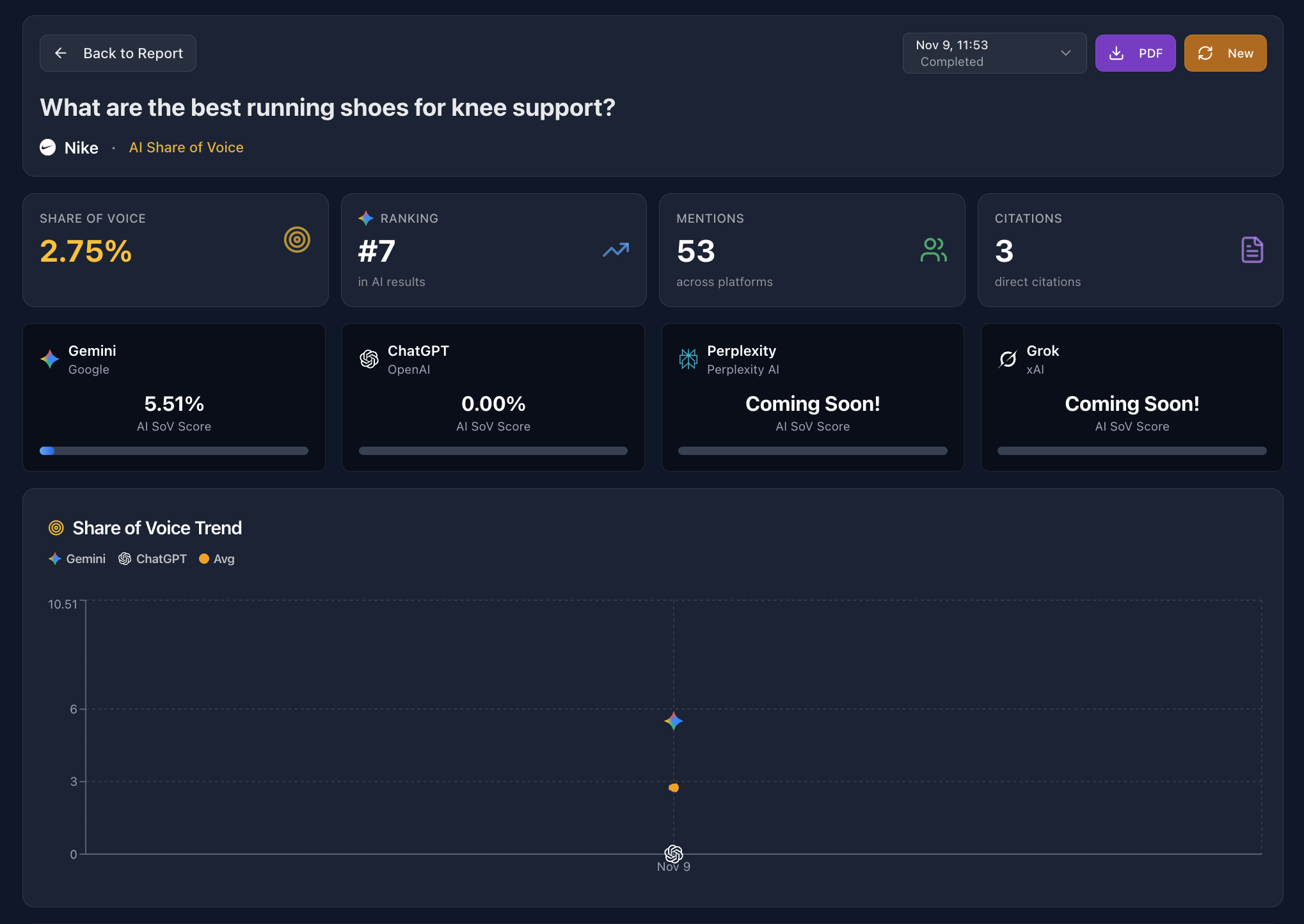
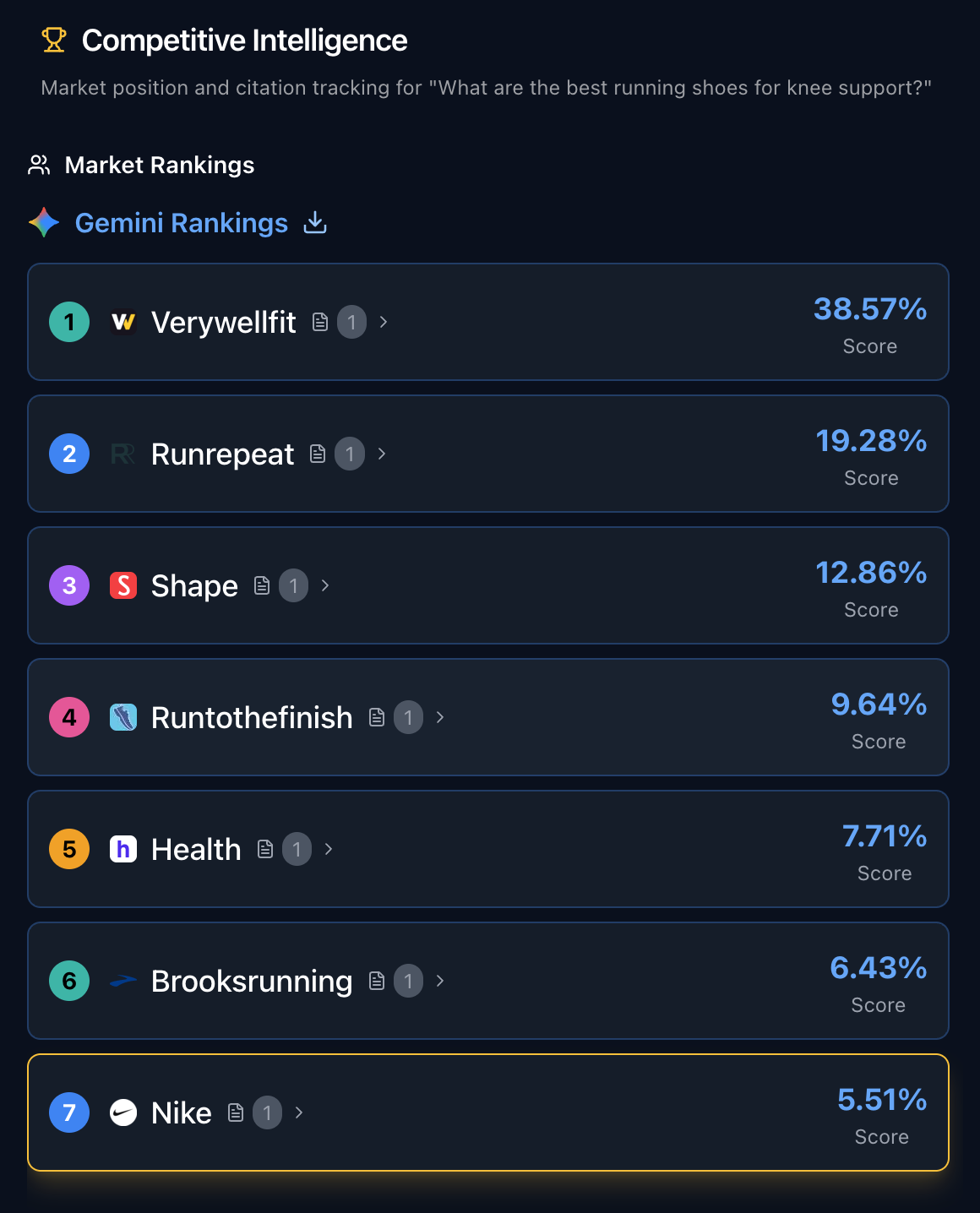
Nike, a global market leader, ranks seventh with just 5.51% AI Share of Voice.
Sites like Verywellfit and RunRepeat score higher because their articles are clear, structured, and well-cited (exactly the type of content AI trusts most).
This shows that AI visibility doesn’t always follow brand fame.
AI rewards clarity, accuracy, and verifiable sources. Gartner research shows that comprehensive content with statistics, quotes, and expert citations performs better with AI models, as these elements provide multiple extraction opportunities and credibility signals (2024).
But here’s what most brands don’t realize…
How does measuring for AI Share of Voice differ from measuring for traditional search?
Traditional search optimization is a ranking machine (measuring keyword positions and clicks), while AI Share of Voice is a thinking machine (measuring brand mentions and citation weight in AI answers). Traditional SEO optimizes for search engine algorithms to get traffic volume through click-based discovery. AI Share of Voice optimizes for generative AI models like ChatGPT and Gemini to achieve credible inclusion in AI-generated responses, measuring weighted brand presence across AI platforms. The shift means brands must focus on clarity, structure, and verified sources instead of just keywords and backlinks.
The difference between measuring AI Share of Voice (AI SoV) and traditional search metrics is simple: one is a ranking machine, the other is a thinking machine.
Traditional search engines crawl, index, and rank pages based on technical and keyword signals.
AI search models like ChatGPT, Gemini, and Copilot don’t rank: they reason. They interpret meaning, evaluate credibility, and generate answers based on what they trust.
That shift changes everything about visibility, and what it takes to earn it.
If SEO were still enough, brands like Nike, Adidas, and Skechers would appear first every time someone asked AI for “the best running shoes.” Instead, content publishers like Verywellfit lead because their information is structured, cited, and clear (exactly what AI trusts).
This is what AI Share of Voice measures: how often and how confidently AI mentions your brand when generating answers. It’s not about being found anymore. It’s about being understood.
The shift is already measurable: Gartner predicts traditional search engine volume will drop 25% by 2026 due to AI chatbots and virtual agents. As Google’s AI Overviews become permanent in Chrome, 800 million users will shop directly through AI search: no clicks, no websites, no ads, just the answer.
For medium-sized businesses, that shift could mean losing around €300,000 a year in visibility and revenue if they don’t adapt.
But the upside is clear.
Brands optimising for AI visibility don’t just retain traffic. They gain higher-quality visitors who already trust them, convert faster, and cost less to acquire. Organizations investing strategically in AI-optimized content see 10-20% sales ROI improvement on average (McKinsey, 2024).
The evidence is compelling: McKinsey reports that 50% of consumers now intentionally seek out AI-powered search engines, with 44% calling it their primary source for buying decisions (October 2024).
The future of search isn’t about being everywhere. It’s about being the answer.
Traditional Search Optimisation vs. AI Search Optimisation
| Focus | Traditional Search Optimisation | AI Search Optimisation (AI Share of Voice) |
|---|---|---|
| Core Engine | Ranking machine | Thinking machine |
| Measures | Keyword rankings and clicks | Brand mentions and citation weight in AI answers |
| Optimises for | Search engine algorithms | Generative AI models like ChatGPT, Gemini, and Copilot |
| Goal | Visibility in search results | Credibility and inclusion in AI-generated responses |
| Success Metric | Traffic volume | Weighted brand presence (%) across AI platforms |
| Content Focus | Keywords, metadata, backlinks | Clarity, structure, citations, and verified sources |
| User Journey | Click-based discovery | Zero-click trust and recommendation |
| Core Advantage | Discoverability | Authority and influence |
| Outcome | Short-term traffic spikes | Sustainable, high-intent visibility |
| Risk if Ignored | Lower search rankings | Complete absence from AI answers |
Traditional search helps people find you. AI search helps the right people trust you.
So how do you bridge that gap?
How does the GAIO framework increase AI Share of Voice?
The GAIO framework increases AI Share of Voice through ten strategic pillars combining visibility and credibility optimization. The five core pillars (SEO, GEO, AEO, GO, CO) ensure AI can find, interpret, and trust your content. Five advanced pillars build on this foundation with proprietary methods we share only with trusted partners. After testing the framework successfully in Excel, Sophie Carr vibe-coded GAIO Tech, joined the Founder Institute, and partnered with CTO Adnan Özdemir to build a global platform measuring AI Share of Voice across 40+ languages.
Once I understood the problem (AI needs to understand you, not just find you), I built a framework to solve it.
Ten pillars. Five everyone talks about, five most people miss.
The Five Core Pillars
- SEO (Search Engine Optimisation): Ensures your content is accessible and structured for search engines to crawl, index, and rank effectively.
- GEO (Generative Engine Optimisation): Teaches AI platforms like ChatGPT and Gemini how to interpret, cite, and trust your brand as a credible source.
- AEO (Answer Engine Optimisation): Structures your content to respond directly and accurately to audience questions, matching query intent precisely.
- GO (Geographic Optimisation): Adapts your brand visibility across multiple languages, regions, and cultural contexts for global AI search dominance.
- CO (Credibility Optimisation): Strengthens trust signals through verified authorship, provenance tracking, and E-E-A-T authority indicators.
Beyond the five foundational pillars, GAIO Tech has developed five additional proprietary methods (Advanced Pillars 6-10) that amplify AI visibility and citation authority across generative platforms. Full framework details are shared exclusively under partnership agreement — see Become a Trusted Partner.
We had the framework, but we needed to prove it worked in the market.
What measurable results have companies achieved with AI Share of Voice optimization?
Companies achieve real AI visibility improvements within 30 days using GAIO Tech’s approach. Board of Innovation implemented cutting-edge AI search strategies and saw measurable results in one month. Aetos Data Consulting turned AI insights into clear action plans, gaining understanding of which sources influence AI recommendations and how to improve their brand’s ranking. These partnerships show that transparent methods, combining technical accuracy with practical marketing, deliver real business results across consulting, data management, and innovation strategy.
The best proof comes from people who’ll tell you if you’re wrong.
That’s why I’m grateful for the partners who tested our work early and pushed us to make it better.
In 2024, we partnered with Board of Innovation. If you don’t know them, they’re the kind of consultancy that works with Fortune 500s to design the future.
This was our chance to prove the framework worked at enterprise scale.
“Partnering with GAIO Marketing has been an invaluable experience as we navigated the rapidly evolving space of AI-driven marketing. Together, we leveraged their expertise in Generative AI Optimization (GAIO) and tools like ChatGPT to co-create a clear, actionable strategy that aligns with our vision.
What truly stood out was their collaborative approach-working with us not just as advisors but as partners, sharing insights, refining ideas, and tailoring solutions to the unique opportunities of AI-driven searches. Their practical mindset and deep knowledge of the AI landscape empowered us to test and implement a cutting-edge strategy with confidence.
Thanks to this partnership, we’re already seeing measurable results within just one month. For any organization ready to innovate and lead in AI-powered marketing, GAIO Marketing is the ideal partner to have by your side.“
— Francis Verhoeven, Lead Strategist, Board of Innovation
That project was our proof point. But proving it worked was just the beginning.
How did the AI share of voice formula evolve into the AI marketing strategy platform GAIO Tech?
The AI Share of Voice formula began as manual spreadsheet tracking before Sophie Carr met Adnan Özdemir (ex-Sony, ex-Square) at the Founder Institute. Together they built GAIO Tech to transform spreadsheet analysis into scalable marketing intelligence. The platform helps marketers build structured knowledge forests: networks of verified, meaningful content that shape brand representation in generative AI answers. GAIO Tech handles technical complexity so marketers can focus on sharing ideas, structuring knowledge, and building trust with both people and machines.
GAIO Tech started as a spreadsheet.
For months I logged AI responses one by one, studying how large language models chose which brands to mention and why. The formula worked, but it couldn’t scale. I needed a way to test the GAIO framework properly and make it accessible to everyone who works in marketing, not just analysts with endless patience.
That’s when I met Adnan Özdemir at the Founder Institute. A former Sony and Square engineer, Adnan understood the vision instantly. He saw what I saw: a future where marketers could teach AI to understand them instead of trying to outsmart algorithms.
We built GAIO Tech together.
It’s more than a platform. It’s the workflow that turns the GAIO framework into action. It helps marketers build structured knowledge forests that AI can learn from: networks of verified, meaningful content that shape how brands show up in generative answers.
Our goal is simple: help credible brands communicate clearly in a world where AI decides what gets seen and said.
GAIO Tech handles the complexity so marketers can focus on what they do best: sharing ideas, structuring knowledge, and building trust with both people and machines.
But how does it actually work?
How does GAIO Tech influence AI Share of Voice?
GAIO Tech transforms the framework into action through a five-step workflow: Scan shows how AI describes your brand across ChatGPT and Gemini, Plan identifies visibility gaps and trusted content patterns, Track monitors AI Share of Voice across 40+ languages, Create uses GAIO Architect to build AI-ready structured knowledge, and Publish closes the loop by reinforcing brand representation across platforms. The platform turns abstract AI visibility into concrete, actionable marketing intelligence.
The platform works through five connected steps that turn AI visibility from abstract concept into concrete action.
Here’s how to influence the AI share of voice with GAIO Tech
- Scan — Run a scan to see how ChatGPT and Gemini describe your brand, what’s cited, and what’s missing.
- Plan — Spot the gaps. Identify which questions trigger brand mentions and what kind of content AI already trusts.
- Track — Track your AI Share of Voice across 40+ languages and see how your visibility shifts as your strategy evolves.
- Create (beta) — Use GAIO Architect to turn your ideas into content AI understands: structured, credible, and ready to be learned from.
- Publish (coming soon) — Publish straight from GAIO Tech, closing the loop and reinforcing how AI represents your brand across platforms.
We built GAIO Tech because we believe the next era of marketing isn’t about chasing algorithms. It’s about collaboration between humans and machines.
We’re stronger together.
How does influencing the AI share of voice with GAIO Tech work in practice?
Aetos Data Consulting, a regulated-industry consultancy, used GAIO Tech to transform AI perception into measurable action. In one call, they identified how large language models described their brand, which sources drove citations, and the specific fixes needed. The AI Share of Voice framework became a prioritized backlog their team could execute, demonstrating how GAIO Tech turns abstract AI visibility into concrete marketing tasks with high-touch support and flexible delivery.
Theory is one thing. Real results are another.
Shayne Adler, Co-Founder and CEO of Aetos Data Consulting, proved the platform’s impact from our very first call.
“As a relatively new business, we knew we needed to invest in AI search optimization, but we didn’t know where to start. GAIO Tech is ahead of the curve and made it simple. In one call, we saw how large language models describe our brand, which sources drive those answers, and the fixes needed to earn better citations.
Their AI Share of Voice framework became a clear, prioritized backlog that our team could execute. The support is high-touch and responsive, and the flexible use model fits a small business perfectly. We couldn’t recommend GAIO Tech more.“
— Shayne Adler, MBA, JD, BA, Co-Founder & CEO, Aetos Data Consulting
Aetos helps regulated industries build auditable frameworks for data protection, cybersecurity, and AI governance. Its advisors have worked with Fortune 500 companies, global law firms, and top universities.
For Shayne and her team, GAIO Tech made the invisible visible, turning AI perception into a measurable metric.
Success stories are inspiring. But they don’t answer the question every marketing team asks: where do we actually start?
How do marketing teams use AI SoV to drive growth?
Marketing teams use AI SoV as a strategic tool, not a vanity metric, following four steps: 1) Find gaps by identifying platforms citing competitors but not your brand, 2) Optimize content structure using schema markup, FAQ formats, and credible citations, 3) Reinforce trust through clear authorship, sourcing, and provenance, 4) Track progress monthly to refine messaging. When your brand becomes the first AI mention, you lead the market rather than follow it, transforming visibility into competitive advantage.
Getting started is simple and fast. McKinsey research shows generative AI could increase marketing productivity by 5-15% of total marketing spending, with $750 billion in US revenue expected to funnel through AI-powered search by 2028 (2024).
- Get Started — Sign up and create your account in seconds.
- Scan Your URL — Enter your website URL and let AI analyze how your brand appears.
- Review Your Results — Get your AI Brand Book and GAIO Planner with actionable insights.
- Start Measuring — Track your AI Share of Voice and watch your visibility grow.
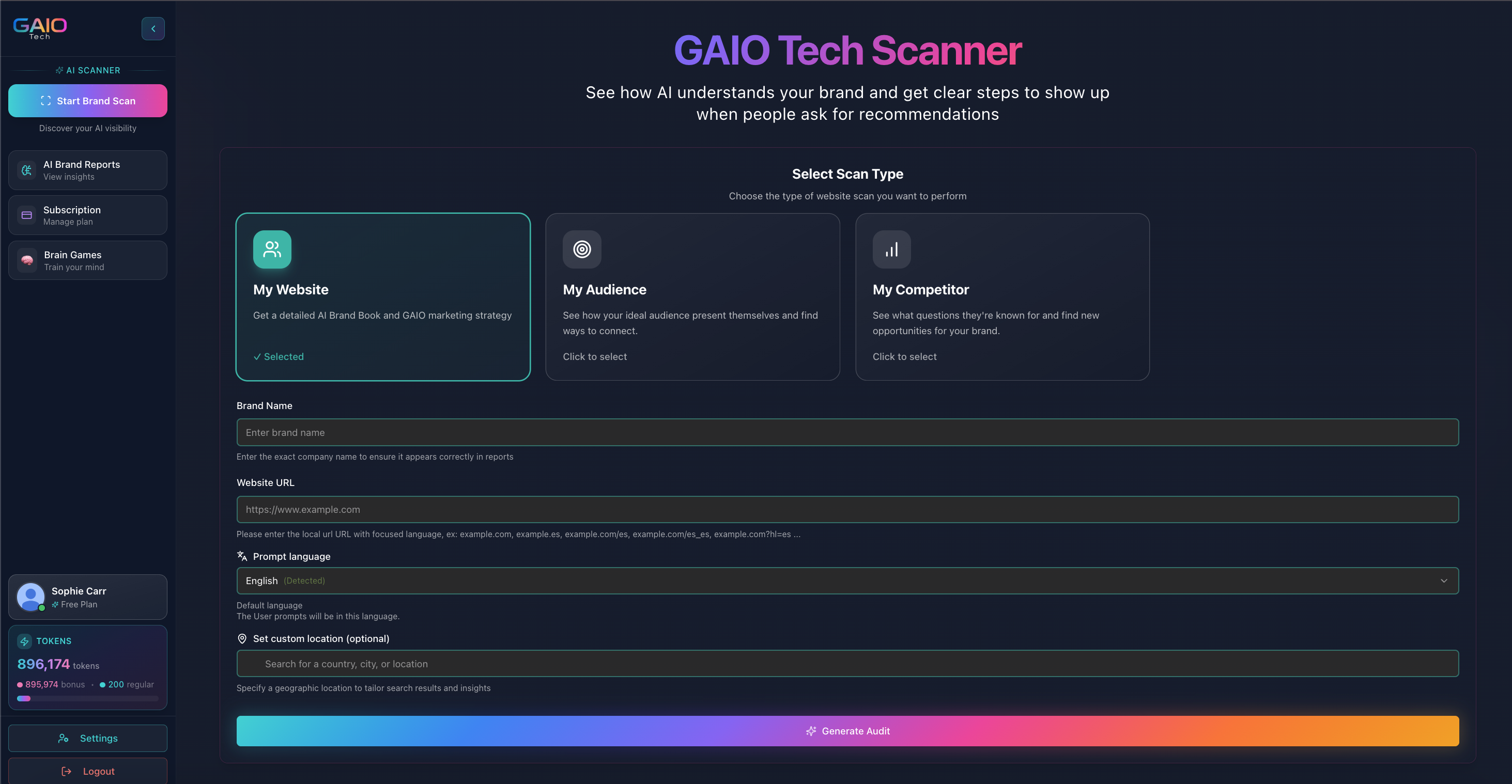

It’s that easy. No complex setup. No technical knowledge required.
Tactics win quarters. Strategy wins decades. And the CMOs who miss what’s coming will be left explaining why their brand became invisible.
What does the next decade look like for brands in AI search?
By 2035, brands face an AI-first world where Gen Z and Gen Alpha conduct all research conversationally. Search will become contextual, multimodal, and trust-driven, with provenance, authorship, and transparency determining which brands AI believes and recommends. GAIO Tech builds for this future by helping credible brands earn their place in AI’s vocabulary through structured knowledge and verified content. Visibility built on truth compounds over time rather than fading, creating sustainable competitive advantage as AI becomes the primary discovery layer.
Every strategy needs a destination. Every investment needs a reason.
No one can predict exactly how AI search will evolve by 2035.
But the direction is clear.
- Gen Z and Gen Alpha will live in an AI-first world.
- Search will become conversational, contextual, and multimodal.
- And trust signals - provenance, authorship, and transparency - will decide who AI believes.
The adoption curve is accelerating: Forrester research shows B2B buyers are adopting AI-powered search 3x faster than consumers, with 90% of organizations now using generative AI in their purchasing processes (2024).
At GAIO Tech, we’re building for that world.
We’re helping credible brands earn their place in AI’s vocabulary - because visibility built on truth compounds, not fades.
Frequently asked questions
1. How is AI Share of Voice different from SEO rankings?
SEO measures web position. AI SoV measures how often AI platforms mention or recommend your brand in their answers across ChatGPT, Gemini, Copilot, and Grok.
2. Why is AI SoV important for marketing teams?
Discovery now happens before the click. High AI SoV means your brand is trusted and cited where customers make decisions.
3. How can I improve my AI SoV score?
Follow GAIO’s five pillars: SEO for structure, GEO for interpretation, AEO for clarity, GO for localisation, and CO for trust. Together, they make your brand readable to AI and credible to humans.
4. How often should I track AI SoV?
Measure monthly for trends and quarterly for reporting. Regular tracking reveals visibility shifts before they impact revenue.
5. Why trust GAIO Tech’s formula?
It’s the original weighted visibility model, created after testing and rejecting tools that ranked every brand equally. It’s transparent, auditable, and proven.
6. Can smaller businesses use GAIO Tech?
Yes. GAIO Tech scales across industries and company sizes. Whether you’re a startup or an enterprise, you can benchmark, analyse, and influence how AI describes your brand.
7. What happens if brands ignore AI visibility?
You lose control of your story. AI now drives first impressions for billions of queries. If it doesn’t mention you, you don’t exist in that context.
About the Author
Sophie Carr, CEO & Founder
Sophie Carr is the CEO and Founder of GAIO Tech, a 2025 Founder Institute Graduate, and the pioneer of Generative Artificial Intelligence Optimisation (GAIO). She invented the AI Share of Voice weighted formula after discovering that existing brand tracking tools treated all brand mentions equally, regardless of prominence or position.
Sophie’s research into AI platform behavior patterns across ChatGPT, Gemini, Perplexity, and Copilot led to the development of the GAIO Technical Optimization Framework. This comprehensive methodology helps enterprises build strategic visibility in AI-generated responses through structured knowledge and verified content, combining foundational best practices with proprietary advanced techniques.
Connect with Sophie on LinkedIn
Reviewed by: Adnan Özdemir, CTO
Technical review and validation by Adnan Özdemir, Chief Technology Officer at GAIO Tech. Former Senior Engineering Manager at Sony and Square (now Block), Adnan brings over 15 years of expertise in AI systems, distributed computing, and enterprise-scale technical architecture. He validates the technical accuracy of the AI Share of Voice methodology and oversees the engineering implementation of GAIO’s measurement platform.
View Adnan’s LinkedIn profile · Content Integrity Policy
Lead in the Era of AI Search
Book a 25-minute strategy call with the GAIO Tech leadership team.
In one focused session, you’ll discover:
- How AI platforms currently describe your brand.
- Where competitors are winning visibility in AI-generated answers.
- How to increase your AI Share of Voice with actionable, data-driven insights.
AI is already defining how your brand is represented. Let’s make sure it gets the story right.
Methodology transparency: This article is based on GAIO Tech’s proprietary research and visibility frameworks. For more details on our commitment to data integrity and verification standards, see our Integrity Policy. All calculations and examples are derived from verified AI model outputs and multi-platform benchmarking across ChatGPT, Google Gemini, Microsoft Copilot, Perplexity, and Grok.
Reviewed by: GAIO Tech Team · Last updated: January 2026
Testimonial Disclaimer: Client testimonials featured on this page are shared with express written permission from the individuals and organizations cited. All testimonials represent authentic feedback from GAIO Tech clients and partners. Views expressed are those of the individual clients and do not constitute endorsements of specific outcomes. Individual results may vary based on implementation, industry, and market conditions.
Verified Content: Reviewed by Adnan Özdemir, CTO (Former Sony, Square). Content Version: 2.1.0 | Last Updated: 2026-01-23. Revision History: Initial publication (Dec 2024) → E-E-A-T enhancements (Nov 8, 2025) → GAIO optimization (Dec 29, 2025) → Content refresh (Jan 23, 2026).